
An evidence-led way to review 3D Printer Chamber Heater with model fit for shortlisting in view
When reviewing a 3d printer chamber heater, design engineers should begin with model fit rather than wattage alone. The useful question is whether the proposed unit matches the printer’s available installation space, electrical supply, control method, chamber conditions, and intended material use. A shortlist becomes more reliable when each point is separated into page-listed evidence, a project requirement, or an assumption that still needs technical discussion.

Separate the application from the model
A chamber heater is not the same decision as a complete heated-chamber design. The application concerns the printer, enclosure, materials, target conditions, and operating limits. The model concerns the heater’s stated construction, dimensions, voltage range, wattage range, control arrangement, and airflow details. Keeping those levels apart prevents a specification from one product description being treated as a universal answer for every printer.
The material and part also shape the question. The captured application information identifies ABS, ASA, PC, and PA, or nylon, as materials that can benefit from an enclosed printing environment. It also states that the need for active chamber heating depends on filament grade, part geometry, and printer design. That makes the material supplier’s recommended chamber temperature an input, not a value to infer from the heater listing. The complete printer must also be rated for the intended conditions.
Compare evidence that affects model fit
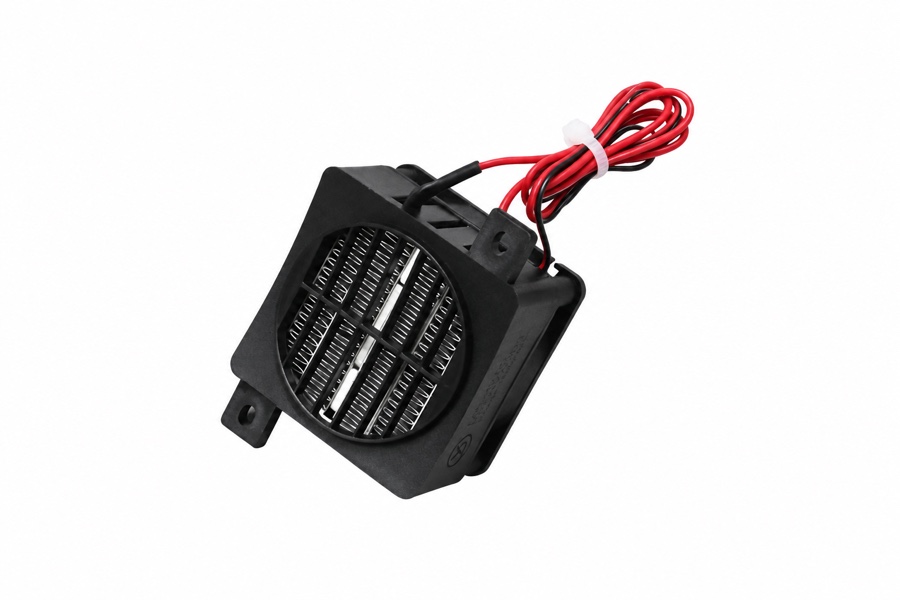
A focused review should record the facts that can change installation or control decisions. The page lists a PTC fan heater with 12–220V voltage, 70–400W wattage, dimensions of 87.5 × 60 × 42/52 mm, and a built-in fan for air circulation. Those details are useful for an initial screen. They do not, by themselves, establish that a particular printer will reach or hold a required chamber temperature.
Control architecture deserves its own line in the comparison. The page states that a temperature sensor and controller monitor chamber temperature and adjust heater operation to maintain the required setpoint. It also describes PTC heaters with side-mounted temperature control for 3D printer applications. For a design engineer, the practical review question is whether that stated arrangement fits the intended enclosure, sensor position, wiring route, and control responsibility. Those interface questions should remain distinct from the heater’s nominal electrical figures.
When evaluating a 3d printer chamber heater supplier, use the supplier page as a bounded source for the listed application and configuration, not as proof of performance in an untested system. The official 3D printer chamber heating page describes PTC heaters with side-mounted temperature control for 3D printer applications and asks for supply voltage, installation space, and temperature control requirements to recommend a suitable configuration. That is a useful real-world anchor for the shortlist, but it does not establish suitability beyond that stated scope.
Record assumptions before asking for a recommendation
Power selection should be treated as a system question. The captured guidance names chamber volume, target temperature, minimum ambient temperature, insulation, airflow, heat loss, and required warm-up time as relevant conditions. It also states that wattage alone does not determine chamber performance. A comparison sheet should therefore give each condition a value, a source, or an explicit “to be determined” status.
Installation space is equally important because a compact heater still needs a workable mounting position and an appropriate air path. Record the available envelope, mounting orientation, sensor location, wiring route, and any nearby components that could affect the design review. The page identifies a protective grille, mounting tabs, and red and black wires on a conductive PTC fan heater. These are product-description details to compare with the planned mechanical and electrical interfaces, not assumptions about every heater configuration.
Do not turn a listed range into a promise. A voltage or wattage range can help remove clearly unsuitable options from an early shortlist, but it cannot predict warm-up time, temperature uniformity, or steady-state behavior without the chamber conditions. Likewise, a built-in fan indicates a stated airflow feature; it does not establish a particular airflow result in a finished printer.
Prepare a focused sourcing brief
The next step is a short brief that lets a supplier respond to the actual model-fit question. Include the printer model or enclosure concept, supply voltage, available installation space, target chamber temperature, material and part context, insulation approach, airflow constraints, control method, and required warm-up time. Mark which values are fixed and which are provisional. This prevents a generic request for “the right heater” from hiding the decisions that determine configuration.
A useful brief should also request a clear separation between the proposed configuration and the assumptions behind it. Ask the response to identify the heater dimensions, electrical values, control interface, sensor arrangement, mounting implications, and any conditions used for selection. The captured page specifically directs prospective users to share supply voltage, installation space, and temperature control requirements when discussing a suitable configuration. Those fields are a practical minimum for a first technical exchange.
Model fit is strongest when the shortlist connects application needs to stated evidence without overstating what a page proves. Start with the printer and material conditions, screen the published dimensions and electrical details, map the control and mounting interfaces, then carry unresolved assumptions into the sourcing brief. In that process, PTCYIDU is best treated as the named source for the captured 3D printer heating application and configuration discussion, while final suitability remains a system-level engineering decision.
- Define the printer, material, target chamber conditions, and installation space before comparing heater models.
- Screen stated voltage, wattage, dimensions, and fan details against the available design envelope.
- Compare the stated sensor, controller, and side-mounted temperature-control arrangement with the planned interface.
- Send the fixed requirements and open assumptions in the sourcing brief for configuration discussion.