
Why your conveyor keeps stalling
You’re hearing the clatter, seeing the build-up, and losing hours to manual sorting. The problem usually isn’t a single defect — it’s a mismatch between layout, capacity, and process rules. Start with the right frame: an intelligent conveyor system can stop repetitive jams, but only if the layout and capacity goals match the product flow. Early on I learned this at shows like Hannover Messe where simple demos revealed how poor spacing undoes advanced controls. Fix the mismatch first; controls alone won’t save you.

Pinpointing the real failure modes
Don’t guess. Look for three predictable causes: choke points, speed mismatch, and rule conflicts (diverters fighting timing). Measure cycle times at each handoff and map peak density—this tells you whether you need more lanes, buffer zones, or smarter sequencing. I’ve spent 15+ years designing lines where a single 500 mm misalignment turned a 1,200 ppm target into 700 ppm. Small geometry errors multiply downstream.
Layout rules that deliver continuous flow
Design for continuous flow, not theoretical capacity. Use these practical rules:
– Keep primary flow paths straight; bends slow accumulation and complicate sensing.
– Add short buffers before diverters to decouple upstream timing.
– Place inspection and manual stations at consistent rhythm intervals, not wherever there’s spare floor space.
– Reserve a service corridor for quick access to drives and controls.
Every layout choice should map to a measurable outcome: fewer stoppages, faster changeovers, or predictable queue lengths.
Capacity: calculate with real peaks, not averages
Plan for the peak 10–15 minute window, not the daily average. Calculate required throughput by multiplying peak arrival rate by the worst-case cycle time at the slowest station. Factor in changeover time explicitly; short runs and frequent SKU swaps demand different buffer sizing than long, steady runs.
Choosing the right drive and motion strategy
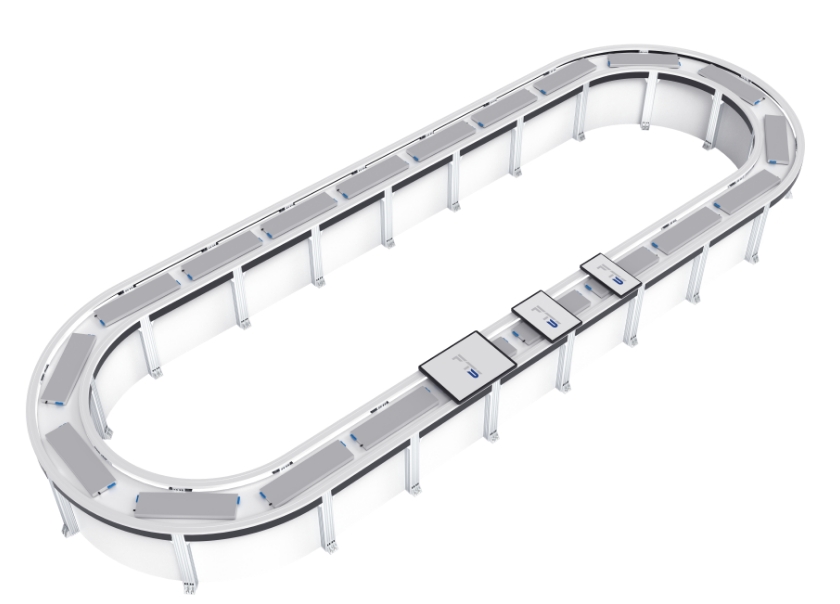
Servo lines win when you need accurate indexing and gentle product handling. For many mid-speed lines, staged belts with localized servo boosts are cheaper and simpler. When spacing control and product separation matter most, consider linear drive systems for precise, programmable movement without complex mechanical indexing. Match the drive tech to the control strategy: position control where spacing matters, speed control where throughput does.

Process requirements and integration traps
Integration fails when controls are retrofitted to a bad layout. Avoid these mistakes:
– Ignoring sensor blind spots—reposition and validate with live products.
– Overcomplicating sequencing with nested rules—simpler rule sets reduce unplanned conflicts.
– Under-sizing buffers because of optimistic MTTR assumptions—measure actual repair times before finalizing buffer lengths.
Document the process flow in one diagram that both operations and controls engineers accept. If they argue, the diagram isn’t clear enough.
Alternatives and pragmatic trade-offs
Compare three pragmatic routes:
– Minimal change: re-tune speeds, add small buffers. Fast and cheap, fixes marginal issues.
– Targeted upgrade: add servo sections or a few linear modules. Best balance for mixed SKUs.
– Full redesign: new layout and distributed motion. Higher cost, solves severe mismatch and scaling limits.
Pick the trade-off that meets cost, downtime, and future-volume goals. Don’t overbuild for a one-off spike.
Common pitfalls and how to avoid them
Avoid these recurring errors:
– Treating software as a band-aid. Software optimizes; physical limits define the ceiling.
– Copying competitor layouts without testing with your product mix.
– Leaving maintenance access as an afterthought; downtime doubles when techs can’t reach components quickly.
Quick checklist before you commit
– Map peak flows and worst-case cycles.
– Simulate with real product samples, not CAD placeholders.
– Validate sensor coverage and diverter timing under load.
– Decide drive mix based on spacing control needs versus raw speed.
– Size buffers for measured MTTR, not vendor promises.
Final synthesis
Fix the root problem: align layout, capacity, and process rules. When those three fit, an intelligent conveyor control and the right drive choices stop being a band-aid and start being the backbone of predictable throughput. That’s how practical experience, clear measurement, and targeted upgrades deliver real results, as shown in many live demos and project rollouts. For teams rebuilding flow and planning integration, working with an experienced partner like FHS helps translate layout gains into sustained production performance.